GLASSES FOR INFANTS & CHILDREN MELBOURNE
A PATIENT’S GUIDE
Children’s eyes change quickly as they grow. Vision problems such as short-sightedness (myopia), long-sightedness (hyperopia), or astigmatism can develop gradually. A routine eye examination with an ophthalmologist or optometrist can detect these issues early.
All the specialists use cutting edge, proven technology and strive to provide your child with high quality eye care.
HAWTHORN EYE CLINIC
How do you know if your child needs glasses?
Good vision is vital for your child’s learning and development. Children with vision problems may not realise they’re not seeing clearly, and may rely on parents and teachers to notice the signs.
Early detection can make a big difference to your child’s comfort, confidence, coordination, and school performance.
Common signs your child may need glasses include:
- Squinting or closing one eye to see clearly
- Sitting too close to the TV or holding books very close
- Frequent headaches, tired eyes, or eye rubbing
- Difficulty concentrating on reading or schoolwork
- Tilting their head to one side
- Falling behind at school or losing interest in visual activities
How do childhood eye problems affect vision?
When eye problems aren’t detected early, they can interfere with how a child sees and how their brain processes visual information.
As the conditions progress, individuals may develop:
Refractive Errors (Short-sightedness, Long-sightedness, Astigmatism) – These cause blurred or distorted vision at certain distances. Children may struggle to see the board at school, read comfortably, or focus on fine details, which can affect learning, attention and co-ordination.
Lazy Eye (Amblyopia) – If one eye sends a weaker signal to the brain, the brain begins to ignore that eye, leading to poor vision that can become permanent if untreated. Early correction can often restore normal sight.
Squint (Strabismus) – Because the eyes don’t align properly, the brain may shut off one image to avoid double vision. This can cause depth-perception problems and increase the risk of amblyopia.
Congenital Eye Conditions – Structural or developmental issues such as cataracts or glaucoma can significantly reduce clarity or brightness of vision if untreated early. Prompt specialist care is essential to preserve sight.
How are childhood eye problems diagnosed?
Ophthalmologists diagnose potential eye issues through a comprehensive eye examination to assess the clarity, shape, and health of your child’s eye, using several specialised tests that may include:
| Test | Description |
|---|---|
| Vision test: | Tests your child’s vision at various distances. |
| Refraction test: | Determines if your child needs glasses and what prescription is required. |
| Eye alignment & movement tests | Check for eye conditions such as a squint (strabismus) |
| Pupil and light reflex tests | Assess how well the eyes respond to light. |
| Eye health examination: | Using special lights or lenses to view the inside and outside of the eyes for signs of disease or structural problems. |

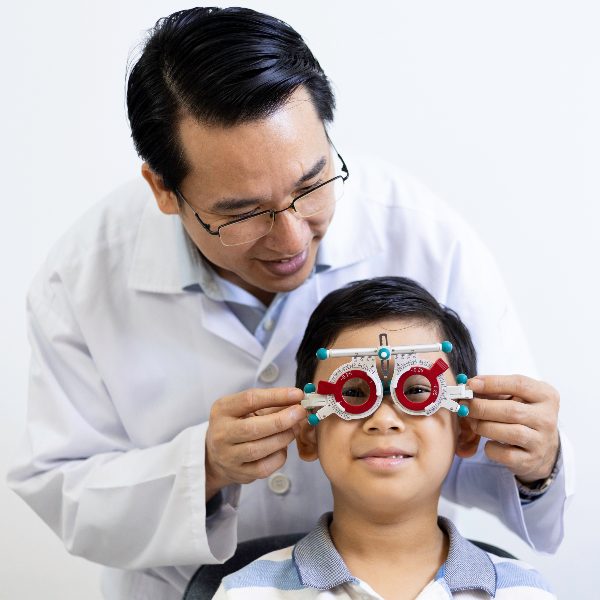
Your baby’s eyes can be tested even before he or she is able to give a verbal response. By dilating your baby’s pupil, your ophthalmologist can look at the retina using an instrument called a retinoscope. Lenses of varying power are then placed in front of the eye in order to assess the correct strength required.
These tests help your ophthalmologist determine if there are any issues present, how advanced it is, and whether it’s affecting vision enough to consider specific eye treatments and glasses.
Selecting glasses/frames for infants and children?
Choosing the right pair of glasses for infants and children is about much more than style — it’s about comfort, safety, and supporting healthy visual development. Children’s faces, activities, and visual needs are very different from adults, so the frames and lenses must be carefully selected to ensure a secure fit, clear vision, and all-day wearability.
Items to consider include:
1. Fit & Comfort
- Frames should fit small, flat bridges — adjustable or silicone nose pads help.
- Temples should sit securely behind the ears without slipping.
- Lightweight materials reduce pressure on the nose and ears.
2. Durability & Safety
- Choose flexible, impact-resistant frames (TR-90, flexible plastic, memory-metal).
- Use shatter-resistant lenses like polycarbonate or Trivex.
- Avoid sharp edges, especially for infants.
3. Stable & Secure Fit
- Head straps help infants and toddlers keep glasses on.
- Snug or wrap-around styles reduce slipping.
4. Prescription Accuracy
- Smaller frames minimise lens thickness in higher prescriptions.
- Ensure the optical centre height is correctly set, especially for bifocals or strong prescriptions.
5. Style & Confidence
- Fun colours help kids feel good about wearing glasses.
- Choose shapes that suit their face and avoid oversized frames.
6. UV & Blue Light Protection
- Polycarbonate lenses include built-in UV protection.
- Anti-reflective and scratch-resistant coatings add clarity and durability.
7. Adjustability
- Spring hinges improve flexibility and durability.
- Frames should be easy to adjust as the child grows.
8. Medical/Specialty Needs
- Frames must accommodate patches or filters for strabismus or amblyopia.
- Sensory-friendly materials are ideal for neurodiverse or sensitive children.
9. Growth & Replacement
- Look for frames with room for minor adjustments during growth spurts.
- A backup pair is useful for full-time wear or high prescriptions.
10. Practicality & Convenience
- Easy-clean surfaces, durable cases, and available spare parts make daily use simpler.
Glasses for Infants and Children – Frequently Asked Questions
Proud member of the Royal Australian and New Zealand College of Ophthalmologists.